Why AI images are useful
More and more people show up with a phone full of images they made in Midjourney, ChatGPT or something similar, often with a slightly guilty look, as if they’d cheated. You haven’t. An image like that tells us more about what you want than ten minutes of describing it: the mood, the subject, how busy or clean it should feel.
The best references come in a small batch. Bring two or three you like rather than one “final” version. Seeing them side by side, your artist can spot what they have in common, and that’s usually the real idea.
Why they don’t work as stencils
The catch is that these tools design for a screen, not for skin. Skin moves, stretches and ages, and ink spreads a little under it over the years. Lines that sit too close together slowly merge, and tiny details turn into a grey smudge. Generated images are full of exactly those things:
- hair-thin lines packed tightly together
- soft gradients with no clear edge to hold them
- details that look great on a phone and fall apart up close, like a hand with six fingers or a pattern that doesn’t quite join up
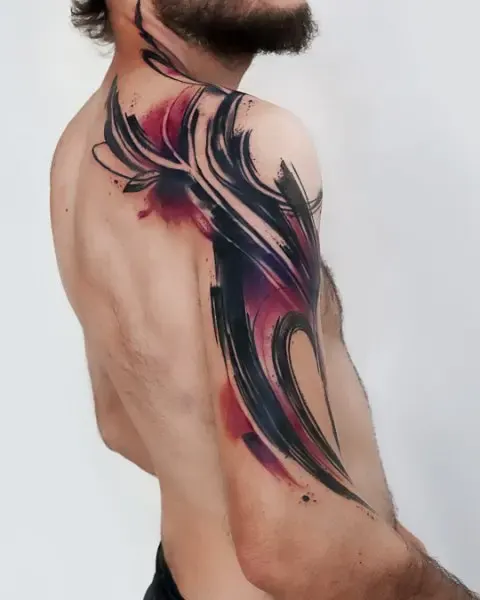
What lasts is pretty much the opposite: lines with room to breathe, clear contrast between dark and light, and a shape that follows the body instead of sitting on it like a sticker. That’s what the redraw is for.
What to bring to your consultation
- Your favourite images, two or three, saved on your phone so you’re not scrolling back through a chat to find them.
- Where you want it, and roughly how big. A palm-sized piece and a half sleeve need very different drawings, even from the same idea.
- What you don’t like about each one. “Love the flow, hate the face” is genuinely useful to hear.
From there, your artist draws the design by hand around your body and in their own style, and you see it before anything is tattooed. If something feels off, that’s the moment to say so. Book a consultation when you’re ready.
Who owns the design?
The short answer is that nobody’s fully sure yet. The rules around AI images are still being worked out, they differ from country to country, and every app has its own terms. If it matters to you, read the terms of the tool you used. We’re tattooers, not lawyers.
What we can tell you is how we see it. The AI image is your reference, like a photo or a sketch on a napkin. The drawing that ends up on your skin is new work, made by your artist for you and your body.
One thing we do ask: please don’t feed another tattoo artist’s work into an AI app and bring us the result to copy. If you love someone’s style that much, the fair thing is to book with them.